 [Ana Sayfa]
ENGLISH SUMMARY
Kemal Gözler, Kayaaltı Çiftliği Tarihi [History of Kayaaltı Farm], Bursa, Ekin, 2025, XVIII+340 s.
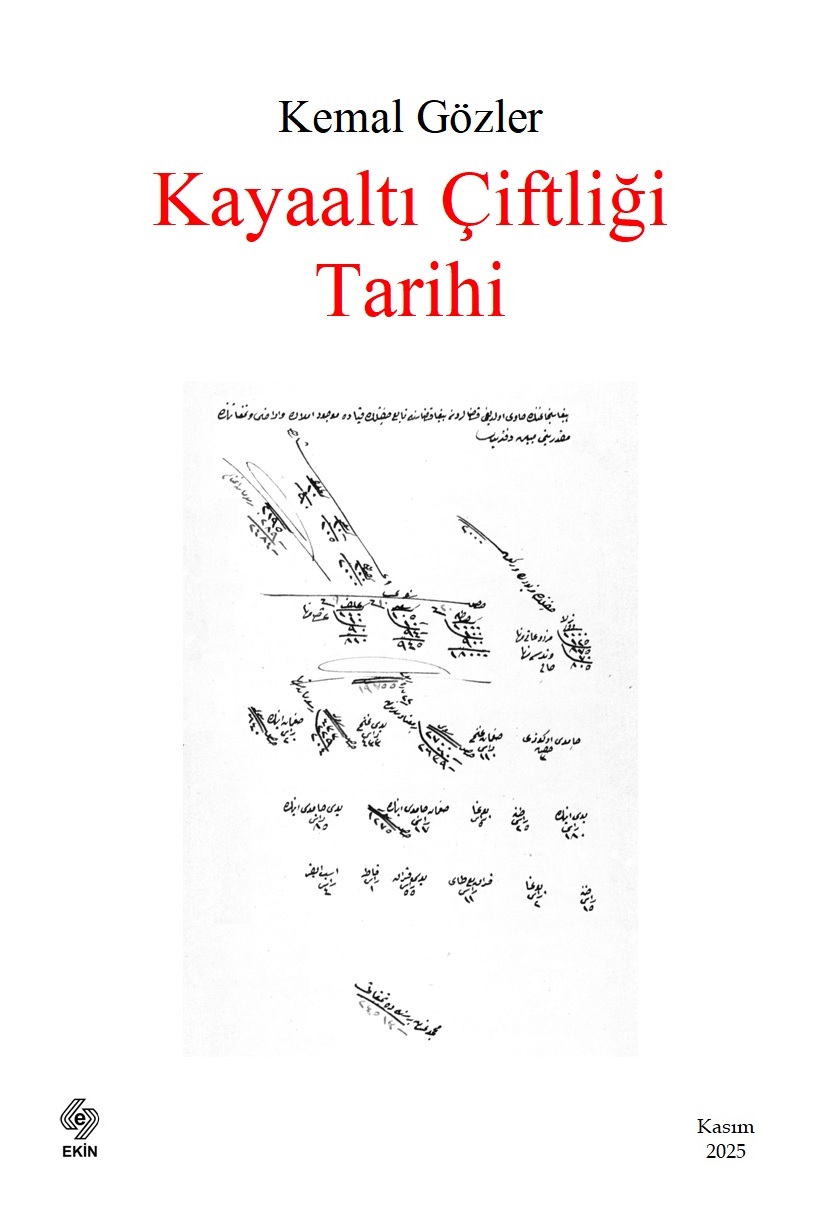
This book examines the history of Kayaaltı Pasture / Community / Village / Farm, located in the Biga district of the Biga Sanjak, during the Ottoman period.
“Kayaaltı” first appears in 1574 as a “winter pasture (kışlak)”. Kayaaltı Winter Pasture became the “Kayaaltı Community (Cemaat)” in 1660, the “Kayaaltı Village (Karye)” in 1696, and the “Kayaaltı Farm (Çiftlik)” in the 1800s.
The first known owner of Kayaaltı Farm was Mehmet Vasıf Pasha. This farm most likely came under his ownership between 1836 and 1838. During these years, Mehmet Vasıf Pasha was the Commander of the Dardanelles and the Governor of the Biga Sanjak.
We do not know the owners of Kayaaltı Farm prior to 1836. In fact, we do not know the status of the farm before this date. It is possible that the land had the status of a timar before this date. We do not know how this status changed and how it came under the ownership of Mehmet Vasıf Pasha.
Kayaaltı Farm passed to Mehmet Rauf Bey, the only son of Mehmet Vasıf Pasha, upon his father's death in 1865. Following the death of Mehmet Rauf Bey in 1875, as a result of a hunting accident at Lake Ece –which was part of the Kayaaltı Farm– the farm passed to his children Hüseyin Vasıf Bey, Emine Müzeyyen, Hatice Saadet, and Zeliha Hanım. At the time of the incident, none of the four children were of legal age. It appears that during these years, the farm was managed by their grandmother, Habibe Hanım, the widow of Mehmet Vasıf Pasha, who served as their guardian.
In 1890, three-quarters of the farm were sold to James William Whittall by Hüseyin Vasıf Bey, Emine Müzeyyen, Hatice Saadet, and Zeliha Hanım. During the transfer, Zeliha Hanım, who was not yet of legal age, was represented by her grandmother. James William Whittall was a Levantine of British nationality. He was the owner of the Whittall Company, one of the largest companies in the Ottoman Empire at the time. He resided in Moda, Istanbul.
It is known that, between 1890 and 1895, three-quarters of the farm belonged to James William Whittall and one-quarter to İsmail Zühtü Bey. However, we do not know who İsmail Zühtü Bey was or how he acquired his one-quarter share of the farm.
Kayaaltı Farm was purchased in 1895 from James William Whittall and İsmail Zühtü Bey by four individuals named Molla Fettah, Hacı İbrahim, Molla Mehmet, and Kasap İbrahim, acting on behalf of 200 immigrant families from Bulgaria, for 5,500 Ottoman liras. This amount was divided into a total of 200 shares, each worth 27.5 Ottoman liras, and paid by the shareholders.
In August 1895, immigrant families arrived at Kayaaltı Farm and established a village called “Lofça-i Cedit (New Lofça).” This village was renamed “Yeniçiftlik” in the 1930s. This is its current name.
The immigrant families who purchased Kayaaltı Farm and founded a village called Lofça-i Cedit on it divided the farm into 200 shares. Each shareholder received 2 decares (dönüms) of land in the village settlement and 60 decares (dönüms) of field on the land. Thus, approximately 13,000 decares of the 32,000-decare farm were divided among the shareholders. 9,000 decares of the farm consisted of Lake Ece. Since it held water in winter, it was excluded from the division. Of the remaining land, approximately 8,000 decares were also not shared among the shareholders and was left as pasture for grazing animals. It can be estimated that approximately 2,000 decares went to common property such as roads, streams, and squares.
Kayaaltı Farm is a farm established on highly fertile land covering 32,000 decares (dönüms) (32 km2). However, until it was purchased by immigrant families in 1895, its contribution to the economy was quite limited.
According to the 1840 Temettüat Defter of Biga, the farm had only 2,500 decares of arable land (tarla) in 1840; of this, only 608 decares were cultivated, the rest remained uncultivated. According to the 1844–1845 Temettüat Defter of Biga, the amount of arable land (tarla) on the farm had fallen to 1,000 decares. Only 125 decares of this could be cultivated; the rest was left fallow.
The contribution of Kayaaltı Farm to the economy in terms of livestock farming is more significant than its contribution in terms of agriculture. According to the 1840 Temettüat Defter, there were 298 head of cattle (cows, buffalo, horses, and camels) and 797 small animals (sheep) at Kayaaltı Farm. However, 278 of the sheep did not belong to the Farm, but to non-Muslim shepherds whom we believe were Bulgarian or Vlach. In 1840, in addition to these five shepherds, 16 black male slaves (zenci gulam) and 5 black female slaves (zenci cariye) worked on the Farm.
According to the 1844-1845 Temettüat Defteri, there were 426 head of cattle (cows, buffalo, and horses) and 533 sheep at Kayaaltı Farm.
It appears that in 1895, a large portion of the Kayaaltı Farm's land remained uncultivated. It can be said that Kayaaltı Farm truly began contributing to the country's agricultural economy in 1895 only after it was purchased by 200 immigrant families and a village was established on it.
The diagram on the following page shows the changes in ownership of the Kayaaltı Farm throughout its historical development.
The book is available in open access at Google Books
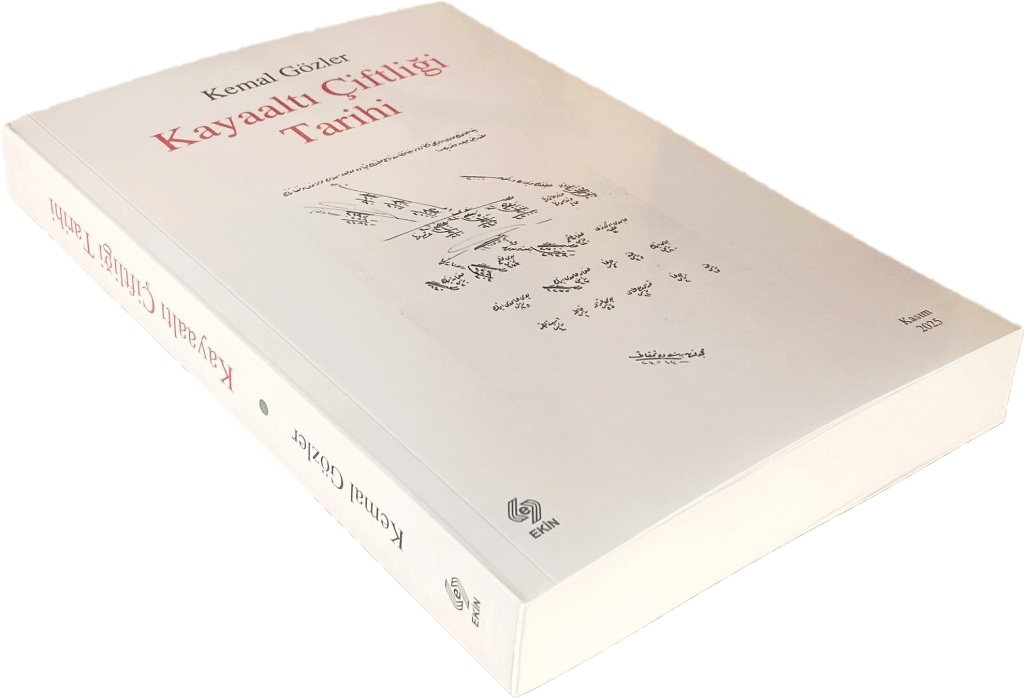
To order the paper book, click on the following link: wwww.ekinkitap.com
COPYRIGHT
(c) Kemal Gözler, 2025. Editor: Kemal Gözler E-mail: Home: www.kemalgozler.com
This Page: www.kemalgozler.com/kayaalti.htm
Date: 5 December 2025
Home: www.kemalgozler.com
This Page: www.kemalgozler.com/kayaalti.htm
Date: 5 December 2025
 linkedin.com/in/kemal-gözler-4aaa6737a/
 twitter.com/k_gozler